martes, 24 de marzo de 2015

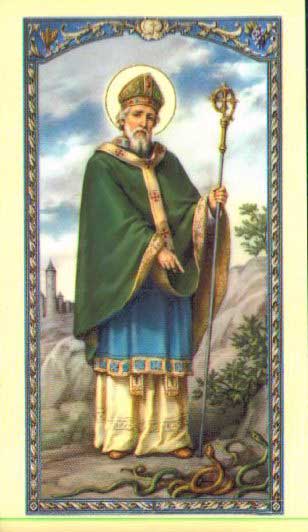
St. Patrick's Day


  • St. Patrick was a Christian missionary and is known as the patron saint of Ireland, together with St. Bridget and St. Columba. It was a preacher and religious of Britain, traditionally considered the introducer of Christianity on the island. St. Patrick’s Day is celebrated the 17th of March in Ireland, because it is the date of his death.


  • This is a type clover that encloses magical and legendary connotations inherited from the Celtic tradition. It is a representation of the culture of the island of Ireland and his exaltation is visible in the celebrations of St. Patrick's Day.


  • The absence of snakes in Ireland gave rise to the legend that they had all been banished by St. Patrick chasing them into the sea after they attacked him during a 40-day fast he was undertaking on top of a hill.


  • Widespread tradition of green on this holiday commemorates his use St. Patrick Shamrock though, curiously, the color originally associated with their clothes off blue.

  • Green also related to the predominant color in the Irish landscape, greenery that gave rise to the nickname "Emerald Isle" with which Ireland is known.


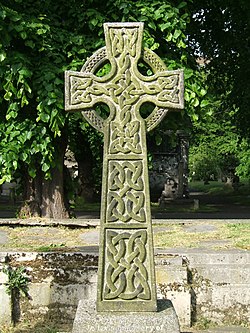
  • A popular legend in Ireland states that the "Celtic” Cross was introduced by Saint Patrick for the evangelization of the pagans of the island, but there is no longer cross from those early days . It also says that St. Patrick joined circular sun or moon Christian symbol representation, thus linking the meaning of the cross pagan spirituality to better convey your message.


  • A leprechaun is a type of elf or fairy men living in the island of Ireland.

viernes, 20 de marzo de 2015

Art and museums in the USA

Metropolitan Museum of Art

Location: New York City
Bordering NYC's Central Park, the Metropolitan Museum of Art is the largest museum in the United States, housing more than two million pieces in its permanent collection curated from Europe, Asia, Africa, and the Middle East. In late 2011 and early 2012, The Met re-opened its renovated galleries of American Art and Islamic Art. Also housed here is the Costume Institute, which contains examples of fashions through the centuries. Must-See Works of Art: Hokusai's "The Great Wave off Kanagawa (left), is a signature piece of The Met's Asian Art collection. The Egyptian Collection includes the Temple of Dendur, an original temple from 15BC. The small European Collection contains works from some of the biggest names - Caravaggio, Vermeer, Rembrandt, Van Gogh, Renoir, Gauguin, Monet.

National Gallery of Art

Location: Washington, DC
The National Gallery of Art, established in 1937, is the United States' national collection of fine art housed on the National Mall in Washington, DC. The museum is split into West and East Buildings, with the former containing the bulk of the museum's American and European Collections and the latter containing mostly modern art and special exhibition space. Entry to the National Gallery is free. (Note: The National Gallery of Art is not under the jurisdiction of the Smithsonian Institution.) Must-See Works of Art: The NGA's prized posession is the portrait of Ginevra de' Benci by Leonardo da Vinci (left). This is the only Leonardo painting in the Americas.

Museum of Modern Art

Location: New York City
The Museum of Modern Art in Midtown Manhattan contains a vast collection of Modernist art and organizes regular exhibitions of contemporary art in its recently remodeled galleries. Some of the 20th Century's most recognizable paintings by the likes of Van Gogh, Rousseau, Pollock, and Picasso grace the walls of the MoMA. Visitor's Tips for the MoMA: Note that admission to the MoMA is free on Fridays from 4-8 p.m. (expect crowds). The Modern, the restaurant that is open only to museum patrons, is one of New York City's Michelin-starred restaurants The Modern does not accept reservations. Must-See Works of Art: Vincent Van Gogh's "Starry Night" is incredible to see in person. Other must-see works include "The Sleeping Gypsy" by Henri Rousseau; "Number 31" by Jackson Pollock; "Flag" by Jasper Johns; Andy Warhol's "Campbell Soup Cans."

J. Paul Getty Museum

Location: Los Angeles, California
The J. Paul Getty Museum is located in two locations in Los Angeles. The Getty Center, in Brentwood, is the home for the collection of pre-20th Century European paintings, sculpture, and furnishings and 19th and 20th Century photographs from Europe and North America. It is housed in a building designed by architect Richard Meier, and its Central Garden was designed by Robert Irwin. The Getty Center receives the bulk of the Getty Museum's total visitors, but the Getty Villa, located in Pacific Palisades, is also impressive. Here is where the Getty displays its collection of antiquities, some of which have been controversial (see the book "Chasing Aphrodite" [Compare Prices]). Must-See Works of Art:Van Gogh's "Irises;" "Venus Reclining on a Sea Monster with Cupid" by John Deare; "The Supper at Emmaus" by Bartolomeo Cavarozzi.

Art Institute of Chicago

Location: Chicago, Illinois
Impressionist and Post-Impressionist Art are the highlights of the collection at The Art Institute of Chicago, a renowned museum located in the city's Grant Park. The Art Institute also has a collection of African American art. Must-See Works of Art: Georges Seurat's "A Sunday Afternoon on the Island of La Grande Jatte" (left) is a famous piece in the Art Institute's collection. Additionally, there are numerous paintings from Monet, Manet, Cézanne, Renoir, and Cassatt. In its American Collection, look for Grant Wood's "American Gothic."

Museum of Fine Arts Boston

Location: Boston, Massachusetts
The more than 450,000 works of art that make up the Museum of Fine Arts in Boston make it one of the largest museums in the United States. Its most renowned collections are its American Art, Egyptian Art, and French Impressionist paintings. Thanks to Boston's twinning with the city of Nagoya, Japan, the MFA's Japanese art collection (the Edward S. Morse Collection) is the most extensive outside of Japan. Chinese art is also on display. Must-See Works of Art: John Singleton Copley's portrait of Paul Revere (left). Also noteworthy are Copley's "Watson and the Shark;" Gilbert Stuart's portrait of George Washington; works by Gauguin, Cézanne, Monet.

Young Museum

Location: San Francisco, California
This fine arts institution in San Francisco's Golden Gate Park is renowned for its American Art collection, including a focus on art specifically from California. The de Young museum also has a broad collection of art from the Americas, ranging from pre-Columbian times to the 20th century, and art from Oceania. More than 13,000 textiles and costumes make up the de Young's significant textiles collection. Must-See Works of Art:Wayne Thiebaud's "Three Machines" (left); "Prometheus Bound" by Thomas Cole; Edward Hicks' "Peaceable Kingdom;" and "California Spring" by Albert Bierstadt.

Los Angeles County Museum of Art

Location: Los Angeles, California
The LACMA, as it is usually called, is the largest art museum west of Chicago, with an estimated 100,000 works of art dating from ancient times to present day. Its best known for its American galleries, which focus on pre-Columbian and Latin American art. Thanks to perpetually fine weather, the LACMA has numerous temporary and permanent outdoor installations. Also noteworthy are the Asian art collections, particular its Korean art collection, which is the largest outside of Korea, and some elaborate religious pieces from South Asia. Must-See Works of Art: LACMA's newest star artwork is "Levitated Mass," a boulder sculpture realized by artist Michael Heizer. "Urban Light" (left) by Chris Burden is another iconic installation.

Solomon R. Guggenheim Museum

Location: New York City
Set in a distinctive, Frank Lloyd Wright-designed building on the Upper East Side of Manhattan, the Solomon R. Guggenheim Museum is known for its modern artworks. Originally called The Museum of Non-Objective Painting when it opened in 1939, the Guggenheim started with a collection of American and European abstract and non-objective works. Renamed after its founder in 1952, the Guggenheim now displays its core abstract collection along with works from all manner of contemporary art genres, among them Dada, Impressionism, Pop Art, and Surrealism. Must-See Works of Art: Any number of works by Vasily Kandinsky, an artist for whom a whole gallery is dedicated. "Paris Through the Window" by Marc Chagall; Amedeo Modigliani's "Nude;" the Robert Mapplethorpe Photography Collection.

Smithsonian American Art Museum

Location: Washington, DC

The Smithsonian Institution's most popular museum is the American Art Museum, which is situated in downtown Washington, DC, at Gallery Place. Housed here are works from all genres, from Colonial-era painting to Folk Art, and representing all regions of the United States. Must-See Works of Art:Albert Bierstadt's "Among the Sierra Nevada" (left); "Electronic Superhighway: Continental U.S., Alaska, Hawaii," a nation-shaped video installation by artist Nam June Paik; Georgia O'Keefe's "Manhattan;" and "Cape Cod Morning" by Edward Hopper.

Graffiti: A work of art or vandalism?


Descripción: https://encrypted-tbn3.gstatic.com/images?q=tbn:ANd9GcShcqft4QZHpZXoC1_Po9zW7dZ229SX4UnPnNeE0EAf-A0Oge0hx0syet2F
Descripción: http://www.paulstravelpictures.com/SW-34th-Street-Graffiti-Wall-Gainesville-FL/SW-34th-Street-Graffiti-Wall-Gainesville-FL-003.JPG 34th Street Wall


There are two types of “graffiti”: one is the called street art which are beautiful creative paintings that artists (almost always unknown) paint on the street walls with, most of the times, sprays; the other type is graffiti, which is an act of vandalism that makes the cities’ walls look dirty, on example of graffiti could be those signs that you can see a lot of times on the streets in almost every city.

In the street art there are lettering techniques such as:             
BUBBLE LETTERS
Descripción: http://www.photographyrea.com/wp-content/uploads/2011/01/Graffiti-Alphabets-Bubble-Yellow-Style.jpg


BLOCK LETTERS
Descripción: http://fctags.s3.amazonaws.com/9e474fdb4a91ed4651c73dfb40a82ef72b3767d3.jpg


WILDSTYLE
Descripción: http://upload.wikimedia.org/wikipedia/commons/a/a8/Wildstyle_graffiti.JPG


CALLIGRAFFITI
Descripción: http://media.tumblr.com/tumblr_livwr90I4h1qhr1nt.jpg


Some graffiti painters are Keith Haring, Jean-Michel Basquiat (SAMO), Jose Parla or BANSKY


Descripción: http://cdn.booooooom.com/wp-content/uploads/2008/12/jose_parla_07.jpgDescripción: http://www.popandroll.com/coke-art/Keith_Haring3.jpgDescripción: http://uploads2.wikiart.org/images/jean-michel-basquiat/philistines.jpg
Descripción: http://www.veniceartcrawl.com/wp-content/uploads/2014/01/gr5128c9cb.jpg

St. Valentine's Day

  • Each year on February 14th, many people exchange cards, candy, gifts or flowers with their special “valentine.” The day of romance we call Valentine’s Day is named for a Christian martyr and dates back to the 5th century, but has origins in a Roman holiday.


  • Here are some interesting facts about this “lovely” festivity:

1. The St. Valentine who inspired the holiday may have been two different men.
2. In all, there are about a dozen St. Valentines, plus a pope.
3. Valentine is the patron saint of beekeepers and epilepsy, among many other things.
4. You can find Valentine’s skull in Rome.
5. Chaucer may have invented Valentine’s Day.
6. You can celebrate Valentine’s Day several times a year.


  • But because a lot of people doesn’t know a lot of this facts the bring to their boyfriend or girlfriend a rose and a box of chocolates without knowing that they are celebrating the date in which a man died as a martyr.

Most important inventions since 1950 in the USA

Microwave (1945)

 A microwave oven, commonly referred to as a microwave, is a kitchen appliance that heats and cooks food by bombarding it with electromagnetic radiation. It was invented with a military purpose, but they discovered it heated things so by 1950s is started being used like we use today.


Airbag (1952)

An airbag is a vehicle safety device. It is an occupant restraint system consisting of a flexible fabric envelope or cushion designed to inflate rapidly during an automobile collision. It was developed by Dr Allen S Breed in 1967.


Snowboard (1965)

Snowboards are boards that are usually the width of one's foot longways, with the ability to glide on snow. It has been an Olympic game since 1998, but it started as a home-made table to enjoy snow.


Compact disc (1965)

Compact disc (CD) is a digital optical disc data storage format. The format was originally developed to store and play only sound recordings but was later adapted for storage of data (CD-ROM). American inventor James T. Russell has been credited with inventing the first system to record digital information.  Russell's patent application was first filed in 1966, and he was granted a patent in 1970. Following him, Sony and Philips licensed Russell's patents  in the 1980s.


Handheld calculators (1967)

In the early 1970s, the daily lives of people throughout the developed world were changed profoundly by the invention of Jack Kilby. It was a small electronic machine that could perform basic mathematical problems much more quickly and more accurately than they could be worked out on paper. Calculators expanded the math capabilities of everyone from high school students to businessmen.


Email (1971)
A local inter-user mail (Ray Tomlinson) program incorporating the experimental file transfer program, CPYNET, allowed the first networked electronic mail.


Mobile phone (1973)

It is a phone that can receive telephone calls over a radio link moving around the area. The first handheld cell phone was demonstrated by John F. Mitchell and Dr. Martin Cooper of Motorola.


Personal computers (1976)

Today’s personal computers are drastically different from the massive, hulking machines that emerged out of World War II. By the 1970s, technology had evolved to the point that individuals could purchase unassembled “microcomputers” and program them for fun, but these early PCs could not perform many of the useful tasks that today’s computers can.


Social media (2002)

One of the first social media in the world was Facebook; its creator was Mark Zuckerberg who now owns other important social media such as Whatsapp.


Segway (1997)


 It is a self-balancing personal transportation device with two wheels; can operate in any level pedestrian environment. It was introduced to public in 2001.

lunes, 2 de marzo de 2015

Most Common Crimes in the USA

Basic knowledge

Trial (juicio): jury (jurado) + judge (juez)
Evidence = proof               Innocent = Guilty

Charges

+ Felony (always go to jail)
   Misdemeanor (rarely jail)
-   Ticket (no jail)


1. - Motor vehicle theft

It is the criminal act of stealing a car or a part of it.


2. – Domestic violence

It is the violence produced by a man to a woman or by a woman to a man only for being a man or a woman. It is usually produced by a person you know, almost always by someone of your family.


3. – Underage drinking

The minimum legal age to drink in the USA is 21, but young people uses fake IDs or tell someone older to buy alcohol for them, so it becomes very easy to get it.


4. – Aggravated assault

An attempt is to commit a battery; it is a misdemeanor, not a felony; four elements are required at common law: the apparent, present ability to carry out; an unlawful attempt; to commit a violent injury; upon another.


5. - Rape

It is a form of sexual violence.
Nearly 90000 people were raped in the USA in 2008.
25% of the population will be raped; 89% of the times, a woman is raped by somebody she knows.


6. - Fraud and racketeering

For example: electoral fraud, mail and wire fraud, computer fraud or identity fraud.


7. - Prostitution

It is a misdemeanor (illegal) in all USA except from Las Vegas.
23/100000 people are considerate to be prostitutes and they are often associated with drugs.


8. - Burglary

Buildings can include sheds, barns and all houses.
If you broke something it is considered a misdemeanor, but, in contrast, if you steal something it is a felony.


9. - Drugs

In 2012, an estimated 23.9 million Americans aged 12 or older had used an illicit drug or abused a psychotherapeutic medication.


10. - Murder

Nearly 1 in 15,000 people is murdered in the United States each year.
In the United States the rates of killing are much higher than in many industrialized nations, exceeding those in Canada, many western European nations, and Japan.


jueves, 26 de febrero de 2015

Top 10 unsolved crimes in the USA

1. The Zodiac Killer

The Zodiac Killer was a serial killer who operated in northern California in the late 1960s and early 1970s. The killer's identity remains unknown. Four men and three women between the ages of 16 and 29 were targeted. The killer originated the name "Zodiac" in a series of taunting letters sent to the local Bay Area press. These letters included four cryptograms. Of the four cryptograms sent, only one has been definitively solved.


2. Tupac and Biggie Smalls

On the 1996 night Tupac Shakur was killed in Las Vegas, Suge Knight was nabbed for violating his probation (for stomping a guy); he spent five years in prison. During this time, Knight's former high school classmate and head of security, Reggie Wright Jr., took over the bulk of Knight's duties at Death Row Records, the once–obscenely popular rap imprint, which was about to go downhill.


 3. D.B Cooper

After hijacking a plane Northwest company that made traveling between Portland and Seattle, Cooper got that authorities will provide $ 200,000 in cash and two parachutes in exchange for free the passengers of the flight. He then ordered the pilot to go to Mexico City and in a  desert area between Seattle and Reno, jumped into the gap. Almost forty years later, still has not solved the mystery of the fate of criminal famous after his daredevil jump.


4. Tylenol poisonings


  The Chicago Tylenol murders were a series of poisoning deaths resulting from drug tampering in the Chicago metropolitan area in 1982. The victims had all taken Tylenol-branded acetaminophen capsules that had been laced with potassium cyanide. James William Lewis was convicted of extortion for sending a letter taking credit for the deaths and demanding $1 million to stop them, and he was also the primary suspect in the killings despite living in New York City at the time. The incidents led to reforms in the packaging of over-the-counter substances and to federal anti-tampering laws.


5. The Black Dahlia


"The Black Dahlia" was a nickname given to Elizabeth Short (July 29, 1924 – c. January 15, 1947), an American woman who was the victim of a gruesome and much-publicized murder. Short was found mutilated; her body sliced in half at the waist, on January 15, 1947, in Leimert Park, Los Angeles, California. Short's unsolved murder has been the source of widespread speculation, leading to many suspects, along with several books and film adaptations of the story. Short's murder is one of the oldest unsolved murder cases in Los Angeles history.


6. Jonbenét Ramsey


JonBenét Patricia Ramsey (August 6, 1990 – December 25, 1996) was an American girl who was murdered in her home in Boulder, Colorado in 1996. The six-year-old's body was found about eight hours after she was reported missing, in the basement of the family home, during a police search of the home. She had been struck on the head and strangled. The case remains unsolved, even after several grand jury hearings, and continues to generate public and media interest.

Colorado law enforcement agencies initially suspected Ramsey's parents and her older brother Burke. However, the family was partially exonerated in 2003 when DNA taken from the victim's clothes suggested they were not involved. Her parents were not completely cleared until July 2008. In February 2009, the Boulder Police Department took the case back from the district attorney to reopen the investigation. 


7. Disembodied feet


Since August 2007, five human feet have washed ashore near Vancouver, British Columbia. No bodies, no heads, no clothes, just feet (4 left, 1 right), nearly all still clad in sneakers. Canadian authorities have yet to determine how the feet ended up there or why, though DNA tests matched one of the severed feet to a man who'd been missing for several months. A number of theories have been tossed around, including the possibility of foul play (though coroners familiar with the case say ocean currents and decomposition could have naturally separated the feet from their owners). Others speculate the remains might belong to four unrecovered victims of a 2005 plane crash off Quadra Island.


 8. Gardner Museum


In the early morning hours of March 18, 1990—as the city was preoccupied with Saint Patrick's Day celebrations—a pair of thieves disguised as Boston police officers gained entry to the Isabella Stewart Gardner Museum and stole thirteen works of art. The thieves had to make two trips to their car with the artwork. The theft lasted 81 minutes. The guards remained tied and handcuffed until the police arrived at 8:15 a.m. later that morning.


 9. Jimmy Hoffa


James Riddle "Jimmy" Hoffa (born February 14, 1913 – disappeared July 30, 1975) was an American labor union leader who vanished in late July 1975, aged 62. He is widely believed to have been murdered. Hoffa became involved with organized crime from the early years of his Teamsters work, and this connection continued until his disappearance in 1975. He was convicted of jury tampering, attempted bribery and fraud in 1964. He was imprisoned in 1967 and sentenced to 13 years, after exhausting the appeal process. In mid-1971 he resigned as president of the union, an action that was part of a pardon agreement with President Richard Nixon, to facilitate his release later that year. Nixon blocked Hoffa from union activities until 1980 (which would have been the end of his prison term, had he served the full sentence). Hoffa attempted to overturn this order and to regain support.
Hoffa was last seen in late July 1975, outside the Machus Red Fox, a suburban Detroit restaurant. His disappearance gave rise to many theories as to what happened to him.


 10. Whitechapel


The Whitechapel murders were committed in or near the impoverished Whitechapel district in the East End of London between 3 April 1888 and 13 February 1891. At various points some or all of these eleven unsolved murders of women have been ascribed to the notorious unidentified serial killer known as Jack the Ripper. The Metropolitan Police, City of London Police, and private organizations such as the Whitechapel Vigilance Committee were involved in the search for the killer or killers. Despite extensive inquiries and several arrests, the culprit or culprits evaded identification and capture. The murders drew attention to the poor living conditions in the East End slums, which were subsequently improved. The enduring mystery of who committed the crimes has captured public imagination to the present day.